
Six Years in Malaysia: The Bugs, the Water, and the House Nobody Warned Us About
This article contains affiliate links (advertising).
Looking back on our six years in Malaysia, from 2019 to 2025, there is an entire category of things I simply could not have known until we lived there. The insects. The water. The house, and how we actually got around. This bonus piece collects what didn't fit into the year-by-year entries, written plainly, so that a family considering the same move can arrive prepared.
What you'll find here
- The insects you actually meet, and how they differ from Japan
- Whether a high floor really keeps cockroaches away
- What worked, and what did not work at all
- Why the tap water runs yellow
- Condominium or house, and the reality of heat and getting around
1. The insects: ants, cockroaches, mosquitoes
Let me start with the question I am asked most. In short: ants and cockroaches are part of daily life, and mosquitoes were far rarer than I expected. That was our family's experience across six years.
Ants appear constantly. They are noticeably smaller than the ones back in Japan, and the smallest crumb left overnight would produce a thin marching line by morning. I became far more diligent about wiping down the kitchen than I ever was at home.
Cockroaches are everywhere, and this is worth bracing for: they are considerably larger than in Japan. It took me a while to get used to the size of them.
The surprise was mosquitoes. I had steeled myself for the tropics, and yet we barely encountered them — fewer, honestly, than during a summer at my parents' house in Japan. This surely varies by area and building, so please read it as our experience in the places we lived.
Rodents are not unheard of either. Seeing rat glue traps stocked as ordinary household goods in supermarkets told me a lot about where we were living. At one upmarket resort in Langkawi, one ran straight past us at breakfast, which gave me a genuine fright. It is worth knowing that this can happen even at well-appointed hotels.
💡 A practical note: wipe up spills immediately, and keep food in sealed containers. Those two habits alone cut the ant trails dramatically. In the tropics, how quickly you tidy up is your pest control.
2. Does a high floor really keep them away?
Before we moved, I was told, quite confidently, that cockroaches don't reach above the thirtieth floor. I believed it, and I let it reassure me while we were choosing where to live.
Here is what I found. They come anyway.
I can say that plainly, having lived it. Presumably they travel up through pipework and shared spaces; whatever the route, choosing a high floor did not spare us. If you are about to sign a lease on the strength of that same advice, please know that the floor number is not the deciding factor. Management standards and the state of the plumbing are far more useful things to judge a unit by.
3. What worked, and what didn't
We tried a great deal over six years, and the results divided sharply enough to be worth recording honestly.
For ants, Dettol worked. It is sold as a disinfectant, but diluted with water in a spray bottle and applied along their routes, it visibly changed how often they appeared in our home. That it is available in any local supermarket made it easy to keep up.
On the side of that spray bottle, my younger daughter — still small at the time — had written "bye-bye, ants". The insects themselves are not a fond memory, but that bottle genuinely still makes me smile.
For cockroaches, the answer was a Japanese bait product we carried over — Black Cap. More accurately, we struggled without it. The products we could buy locally were, without exception, ineffective for us. That conclusion came after trying plenty of them, so if you are heading over, I would seriously suggest bringing whatever you already trust from home. We restocked on every trip back.
For the record, there were also things recommended locally as effective that did not clearly work for us. One was a Chinese ant powder (灭蚁清, miejiqing), sold with claims of wiping out the whole nest and three ant-free years. The other was the insecticide chalk widely sold across Southeast Asia (MAGIC INSECTICIDE CHALK) — you draw a line across the ants' route with it, and locally it is treated as a staple.
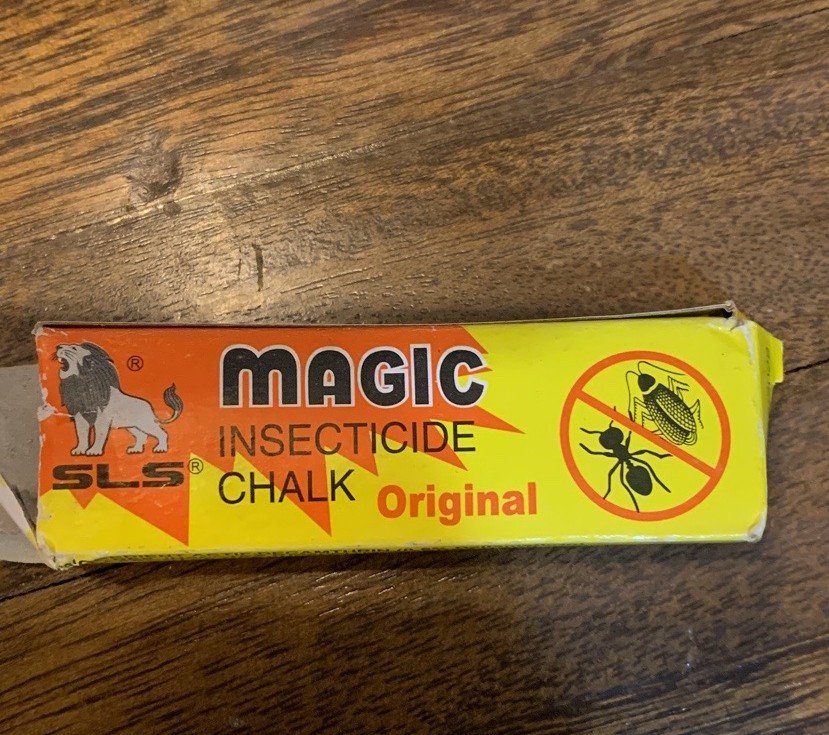
Both are cheap and easy to find, and we used them hopefully. But in our home at least, neither came close to the products we carried from Japan. Results surely vary by building and by species, so I would not claim they never work. What six years taught me is that assuming something works because it is the local staple, and relying on local purchases alone, is a risk.
💡 Packing note: it is tempting to assume you can buy pest control locally, but in our household the Japanese products won outright. Do check airline and destination rules on carrying insecticides before you pack them — quantities and types matter.
4. The water runs yellow, and it doesn't stop
Alongside the insects, water was the thing I could not picture until we lived there. Our tap water carried a yellow tint for the entire six years. Filled into anything clear, the colour was plainly visible, and it takes some getting used to.
This was not simply a matter of living in an older building. I know that because the water was the same at an upmarket hotel in Kuala Lumpur. It is not about how new the fittings are; it is about what arrives through the city's pipes.
Water across the Kuala Lumpur area is supplied by Air Selangor (Pengurusan Air Selangor). The company itself notes that sediment settled in the mains can be stirred up when supply is restored after a disruption, discolouring the water, and advises running the tap for five to ten minutes until it clears. Treated water meets the statutory standards, but residual iron and manganese are known to settle within the distribution network. In older buildings, corroding pipes add rust of their own.
We used a filter and bottled water for drinking and cooking. There is no need to be anxious about it, but do plan on sorting out your water from day one.
📎 Source: Air Selangor guidance and local reporting (Free Malaysia Today, 24 July 2024). Please check official notices for the current situation.
5. Condominium or house?
We spent the first half of our time in a Kuala Lumpur condominium and the second half in a house. Which suits you depends on your family, but living in both taught me something I would not have guessed.
The unexpected luxury of the house was being able to bring the car right up to the front door. Shopping goes straight indoors; children get in and out easily. In a condominium, every trip includes the walk between the car park and the lift. It sounds trivial, and it is — until you do it every single day.
The flip side is that getting the car in and out was a job in itself: the gate, the manoeuvring in a tight space. "Convenient to park at the door" and "a chore to move the car" turned out to live side by side.
6. Heat, getting around, and the eBike answer
This is the part I could never have worked out from a distance.
In Malaysia you cannot walk to the local shops. It is not the distance; it is the heat. The Japanese instinct of "it's only five minutes, let's walk" simply does not survive there. As a result, almost all movement assumes a car.
And yet, as above, getting the car out is a chore. Doing it for every short school run wore on me more than I expected.
What we settled on was an eBike. In the end I did nearly all of my younger daughter's school runs on it. No walking in the heat, and none of the business of moving the car. It sat exactly in the gap between "too hot to walk" and "too much bother to drive". Before we moved, it would never have occurred to me that a bicycle was the answer.
💡 A practical note: when you assess a home, picture the daily school run as concretely as you picture the floor plan. Whether the location leaves you an option other than the car makes a real difference to how the days feel.
7. If you are considering the move
I have deliberately dwelt on the harder side here. But if you can read all of it and still want to go, I think six years in Malaysia will be worth it for your family. It certainly was for ours.
What matters is setting your expectations correctly. The insects come. The water has colour. It is too hot to walk. And within all that, life works perfectly well, and you adjust. Knowing in advance turns the surprises from problems into "ah, so that's how it is".
Q. Will a high floor keep cockroaches out? A. No. I was told they don't come above the thirtieth floor, but they reached us anyway. The floor number is not the deciding factor.
Q. Can I just buy pest control locally? A. You can, but for us the local products were largely ineffective. What we trusted for cockroaches came from Japan. For ants, diluted Dettol in a spray bottle worked well.
Q. Is the tap water drinkable? A. We did not drink or cook with it, using a filter and bottled water instead, because of the discolouration.
📌 Last updated: July 2026. Living conditions and utility guidance change. Please reconfirm with official sources when planning a move.
8. Related reading
- Choosing a school → Choosing an international school
- The visa in practice → How to get an MM2H visa
- Series overview → Six Years in Malaysia
- Making the decision → Relocating to Malaysia for Kids' Education
- The pest-control entry → Malaysia Relocation, Years 3-4
- All articles → Home
This article draws on our family's life in Malaysia between 2019 and 2025. Living conditions change, so please confirm details with official sources when you plan.
Useful for planning
PR: contains affiliate links.